QA Agent in Your CI/CD Pipeline
Your CI/CD pipeline runs tests you wrote last quarter. It has no idea what was Vibe Coded today.
The Problem Nobody Wants to Admit
Your test suite doesn't think. It executes what you told it to check six months ago when the codebase looked different.
Someone opens a PR adding payment retry logic. Your tests pass because they check the happy path. They don't know about the new edge cases that just got introduced.
A human needs to look at that diff, understand what changed, figure out what could break, and write new tests. That takes hours. The PR sits waiting. Your velocity promise evaporates while someone manually thinks through edge cases.
This gets worse with AI-generated code. You vibe-code a feature in 20 minutes. Your QA team spends three days mapping what could break.
Old Way vs New Way
The old way: hire more QA engineers to write test plans faster. Throw people at a capacity problem.
The new way: put an autonomous agent in your CI/CD pipeline that actually thinks about what needs testing.
Not another testing framework. Not a coding agent that dumps out shallow Playwright tests.
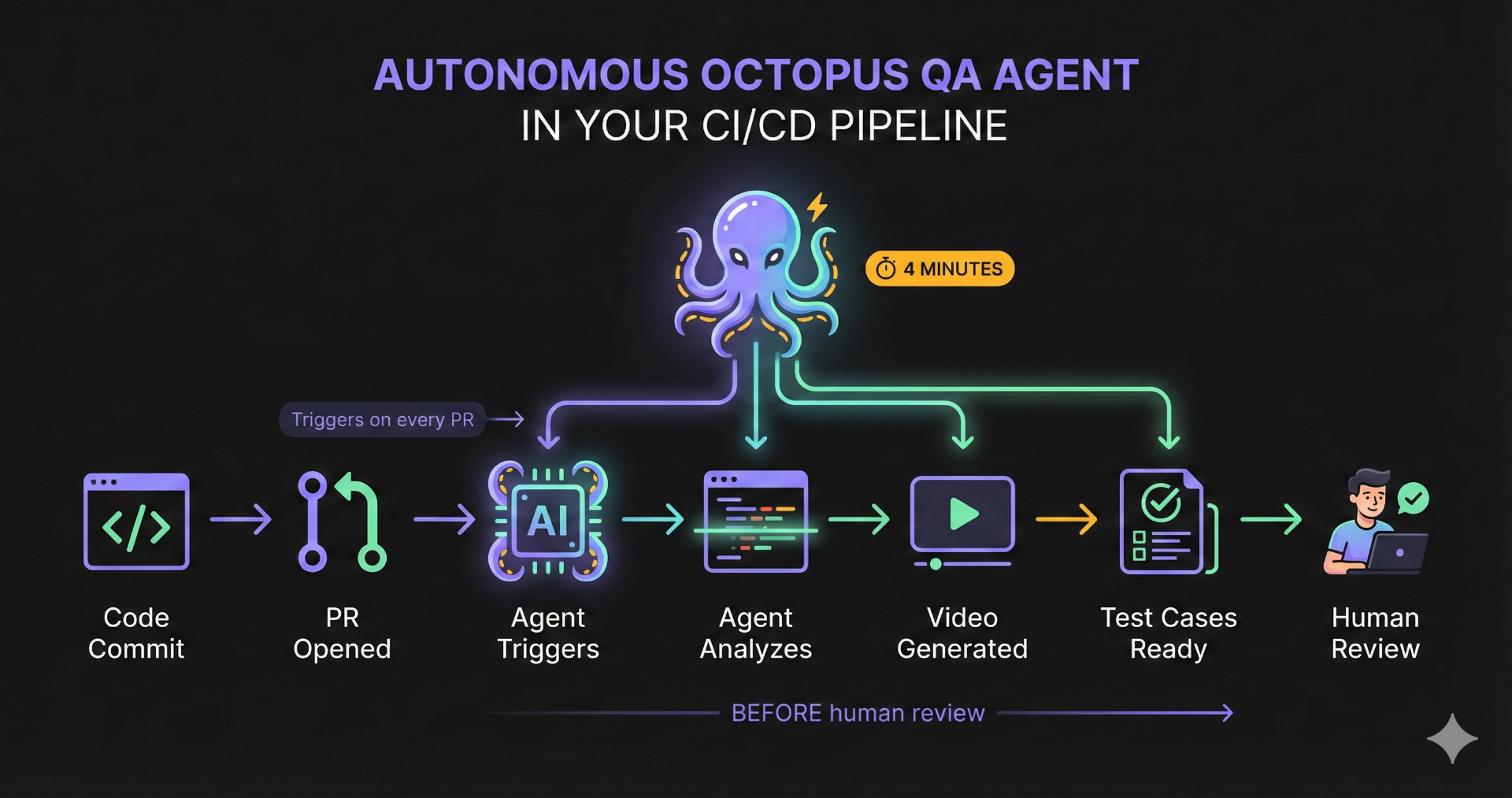
An agent that watches your PRs, analyzes what changed, decides what matters, and generates real coverage before humans even start code review.
What This Actually Looks Like
We integrated this last month. A developer opened a PR with new currency support in the checkout flow.
The agent triggered automatically. It analyzed the diff and spotted 3 edge cases we missed — currency conversion failures, timeout handling, edge cases in the error states.
It clicked through our test environment to verify the changes worked. Then it generated a 90-second video showing the payment flow in action.
The video appeared in PR comments before our first human review.
Our tech lead watched it and immediately spotted a UX issue with the loading state. The spinner disappeared too early on slow connections. Fixed before merge.
By the time we approved the PR, the agent had generated 6 end-to-end test cases ready to pull. We went from hours of manual test planning to minutes of automated analysis.
The Shift That Matters
Your QA engineers stop being test plan writers. They become test plan reviewers and edge case hunters.
The agent handles happy paths, standard error handling, and basic edge cases. Your team reviews the output and adds the non-obvious stuff—business logic quirks, integration gotchas, user behavior patterns that break assumptions.
Better division of labor. Automate repetitive thinking. Use humans for judgment.
What You Get
- → Test plans generated in minutes, not hours
- → Video documentation of how your PR actually works
- → Coverage that adapts to every change automatically
- → QA team focused on high-value work instead of repetitive planning
The agent runs on every PR. You can't ignore it. Coverage increases immediately because it's automatic.
The Reality Check
This doesn't work if your codebase is chaos. The agent needs readable code and clear patterns.
It handles repetitive coverage so they can focus on what automation misses.
Once it's running, the ROI is immediate. Tests get written. Videos get generated. Your team stops drowning in manual work.
Try It
We're opening a waitlist.
If you're shipping AI-generated code fast and testing can't keep up, this changes your workflow.
If you're a CTO watching your QA team drown in manual test planning, this frees them up.
Sign up for the waitlist. We'll help you integrate it into your pipeline.
Stop waiting for humans to think through test plans. Let the agent do it.

Daniel Roedler
Co-founder and CPO at Octomind